By default, a coding agent in DearSQL can do more than read the context you pin — it can query your database directly. That’s what turns “write me a query” into “look at the data and tell me why this is slow”.
DearSQL does this by running a small MCP server on your machine and handing the agent its address when the session starts.
The tools
| Tool | What it does |
|---|---|
list_databases |
Lists your saved connections and whether each is open |
connect_database |
Opens one of them by name |
list_tables |
Lists tables and views, with their columns |
run_query |
Runs a read-only SQL query and returns the rows |
You’ll see each call appear in the transcript as it happens, and can expand it to read what came back.
What’s allowed
run_query only accepts read-only statements — SELECT, SHOW, EXPLAIN, DESCRIBE, WITH, PRAGMA and friends. Anything that writes is rejected before it reaches your database, including a write hidden after a semicolon:
SELECT 1; DROP TABLE users -- rejectedResults are capped at 200 rows and about 60 KB, so a careless SELECT * on a huge table can’t flood the conversation.
connect_database is the one tool that changes DearSQL itself. It opens a connection you’ve already saved — it can’t invent new ones, and it can’t change their settings.
Turning it off
The gear icon opens AI settings, which has Let the agent query my database. It’s on by default.
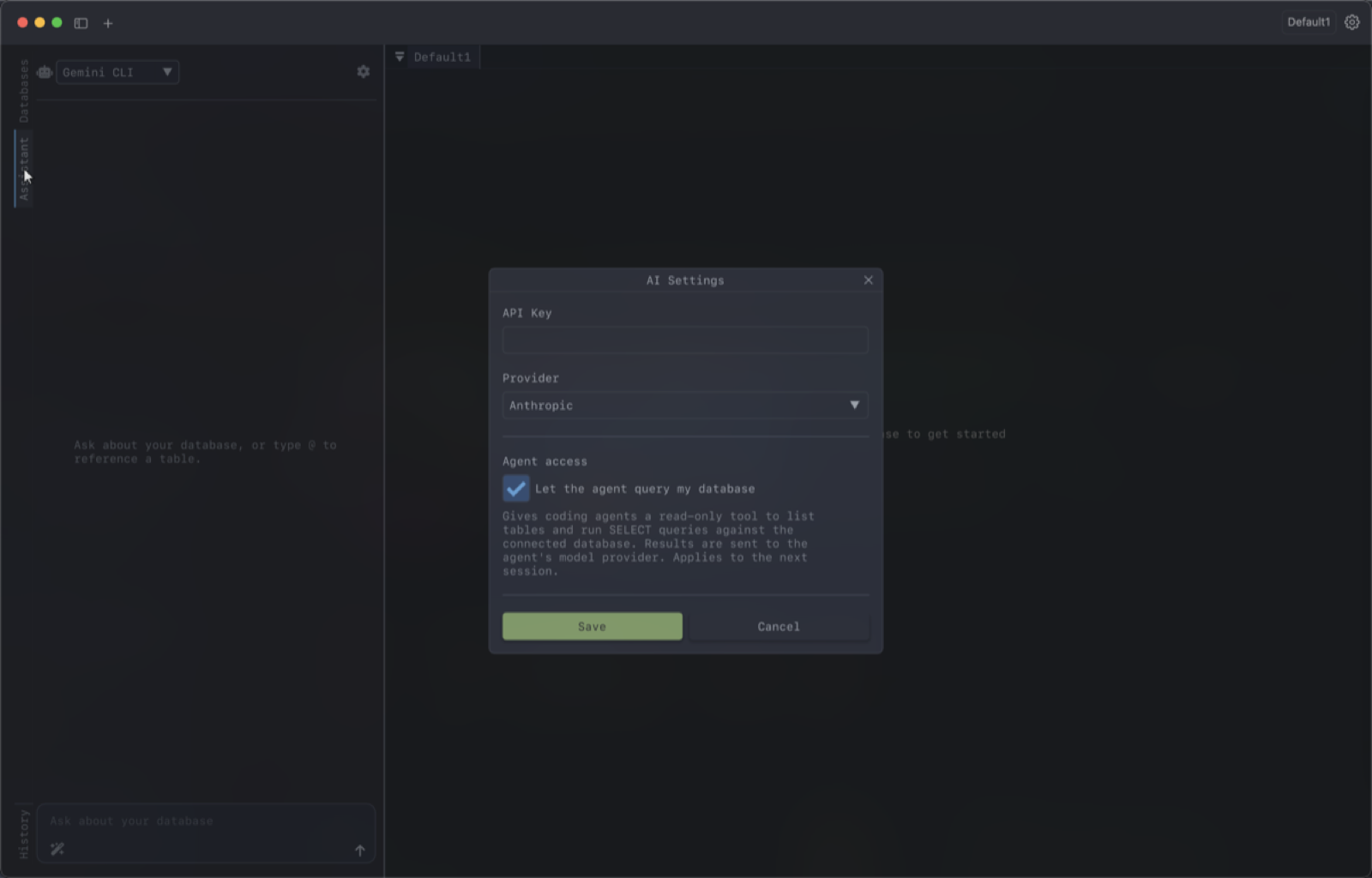
Turning it off stops the running agent and closes the port, so nothing is listening. The assistant still works — it just only knows what you tell it and what you pin with @.
Worth knowing when deciding:
- Query results are sent to whichever model provider your agent uses. Read-only still means the contents of those rows leave your machine.
- The server listens only on
127.0.0.1and every request must carry a bearer token that’s generated fresh for each session and shared only with the agent DearSQL launched. - Letting the agent open connections means it can trigger the side effects of connecting, such as an SSH tunnel or a keychain prompt.
If you’re working against production, it’s reasonable to leave this off and pin schema by hand with @.