Exporting a table
Right-click a table and choose an export format:
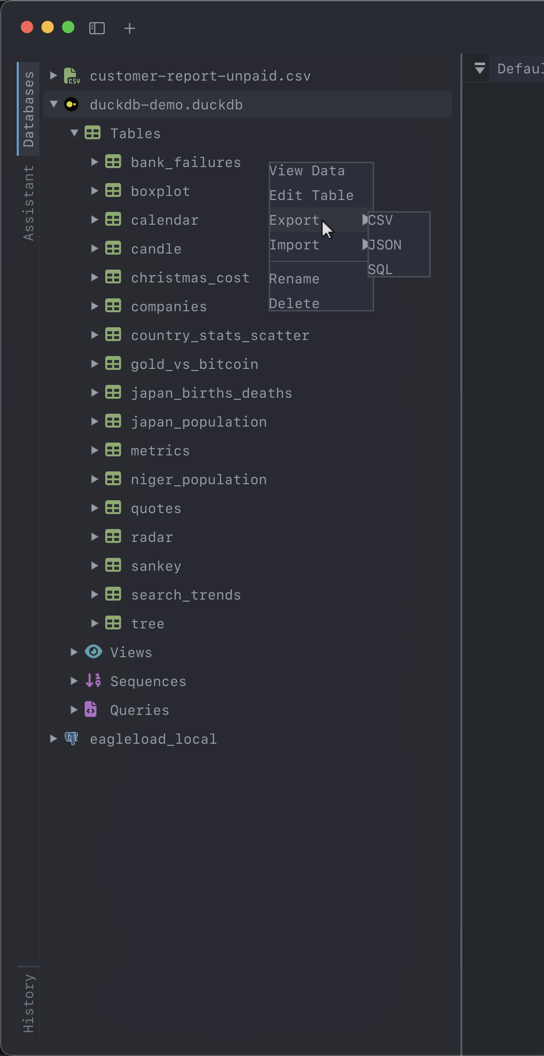
| Format | Good for |
|---|---|
| CSV | Spreadsheets, and anything that eats delimited text |
| JSON | Feeding an API or a script |
| SQL | INSERT statements to replay elsewhere |
| Markdown | Pasting into a pull request, an issue, or notes |
| HTML | A standalone page you can open in a browser or paste into a document |
Markdown escapes pipes and turns newlines into <br>, so a table with awkward content still renders. HTML is written as a complete, self-contained document rather than a bare fragment.
Selecting several tables exports them all — one file each into a folder you pick, except SQL, which writes a single file.
SQL dumps
MySQL and PostgreSQL databases can be dumped to, and restored from, plain SQL — from the database’s context menu.
This runs inside DearSQL. You don’t need mysqldump, pg_dump or a matching client version on your machine, which is usually the thing that makes dumps annoying.
The PostgreSQL exporter follows the same ordering pg_dump uses — schema first, then data, then constraints and indexes — so the output restores cleanly rather than tripping over foreign keys. Data is streamed with COPY, which is considerably faster than a file full of INSERTs.
A dump runs in the background with a progress panel and a Cancel button. While one is running, actions that would tear the connection out from under it — editing the connection, disconnecting, removing it — are disabled with a note explaining why.
Importing shows a preview of what the file contains before anything runs.
PostgreSQL additionally keeps the external Backup and Restore menus, which shell out to pg_dump and pg_restore if you’d rather use the real thing.
CSV files
Open a CSV directly with Open CSV File… in the sidebar’s context menu. DearSQL loads it through DuckDB, so the file behaves like a table: browse it, sort it, filter it, and run SQL against it.
Tables can also be imported from a CSV file, from the table’s context menu.